Matomo vs GA4
Published on | Web Analytics • Data Privacy / GDPR • Tools & Reviews
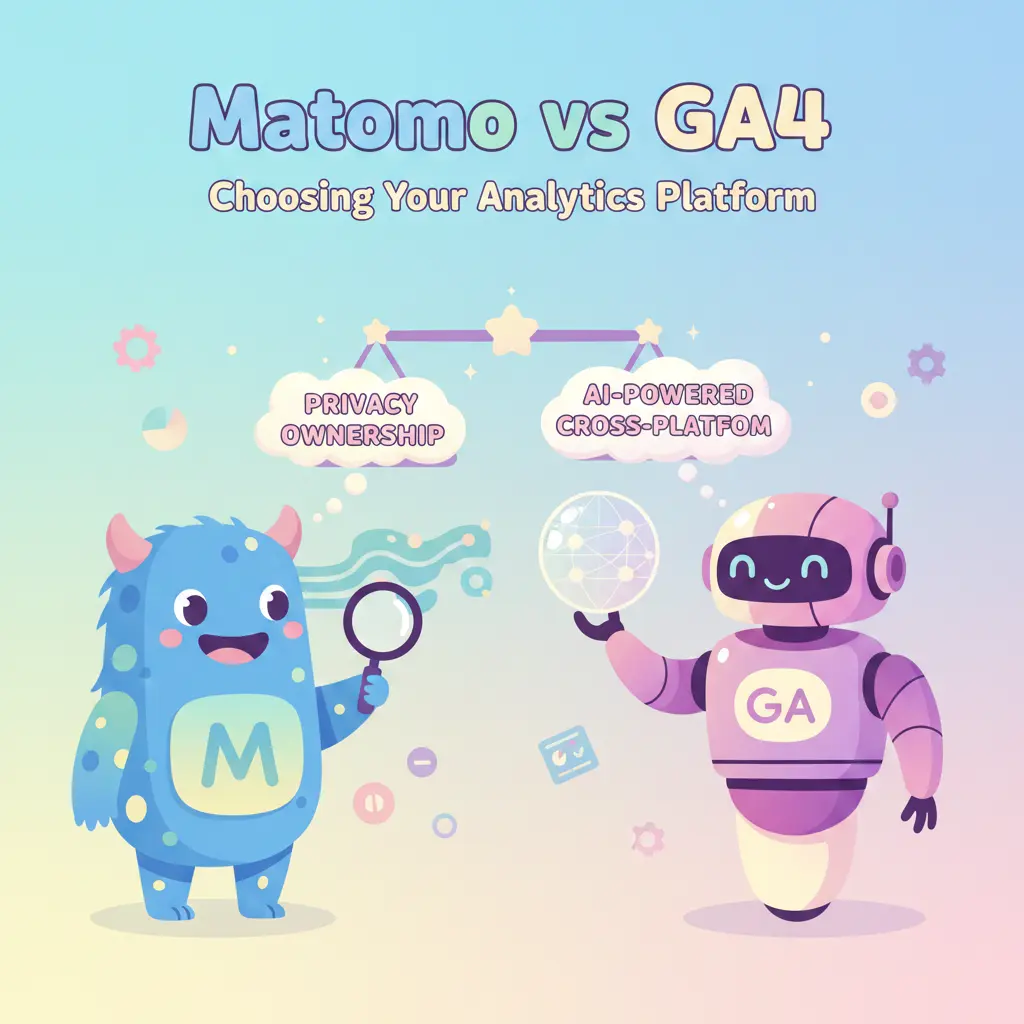
After spending weeks working with GA4 in class, we finally had the chance to explore Matomo and compare the two. In this post, I break down what sets them apart, from pricing and GDPR compliance to A/B testing and AI, and which platform might suit different types of organizations.
Matomo vs GA4: Comparison Table
| Category | Matomo | Google Analytics 4 (GA4) |
|---|---|---|
| Price | • Self-hosted: Free (open source), pay only server/maintenance • Cloud/SaaS: Paid based on traffic |
• Standard GA4: Free • GA360 (Enterprise): Very expensive (tens of thousands+/yr) |
| A/B Testing | Built-in A/B & A/B/n testing included | No built-in A/B testing since Google Optimize was discontinued; requires 3rd-party tools |
| Best for (Organization Types) | • Privacy-sensitive orgs (EU, public sector, healthcare, education, government) • Companies wanting full data ownership • Teams wanting analytics + A/B testing in one tool |
• Startups & SMBs running Google Ads • Marketing-heavy teams wanting deep Google integrations • Enterprises using Google Cloud / BigQuery • Organisations with strong ad focus |
| Ease of Use | • Simple, classic analytics UI • Easier for beginners • Self-hosting may require tech resources |
• Modern but more complex UI due to event-based model • Large learning curve for those used to Universal Analytics |
| Ease to Learn | • Straightforward for basic analytics • Smaller learning curve |
• Many learning resources but more conceptual complexity • Requires event planning/modeling |
| Support | • Community support (free) • Paid support available with Cloud plans • Smaller ecosystem |
• Massive global community • Comprehensive docs & tutorials • Enterprise support with GA360 |
| Integrations & Ecosystem | • Fewer plug-ins/extensions but strong privacy tools • Flexible due to open-source nature |
Extensive integrations (Google Ads, Search Console, BigQuery, Data Studio, DV360, etc.) |
| GDPR / Privacy | Very strong GDPR compliance options • Can self-host data in EU • Strong anonymization & consent features |
GDPR challenges due to US data transfers • Needs careful configuration & legal review in some EU cases |
| Data Ownership | You own 100% of your data (especially self-hosted) | Google controls infrastructure; limited data-control options |
| Hosting | • On-premise or Cloud (your choice) • Full control over location |
• Fully hosted by Google (no self-hosting) |
| Who Should Choose It? | Organisations prioritizing privacy, control, GDPR compliance, or built-in experimentation | Organisations prioritizing ad performance tracking, marketing integrations, and large analytics ecosystem |
Price
- Matomo
- Self-hosted (On-Premise): the software is open-source, you can host it yourself with no license fee (you pay hosting/maintenance). Good for teams that want control and to avoid recurring SaaS bills.
- Matomo Cloud (SaaS): paid tiers based on monthly traffic and features (Matomo’s pricing page / cloud tiers). Exact cost depends on your monthly pageviews and chosen add-ons.
- GA4
- Free tier: GA4 is free for most sites, with quota limits. Great for startups/SMBs with standard needs.
- Google Analytics 360 (enterprise): paid enterprise tier (often quoted in the market at tens of thousands a year, commonly seen ranges like ~$50k+/yr to higher depending on contract and volume). Expect substantial cost for enterprise features/SLAs.
Bottom line: Matomo can be free if you self-host (you still have infra/ops cost). GA4’s free tier is powerful; enterprise scale needs GA360 which is expensive.
A/B testing / Experimentation
- Matomo
- Has built-in A/B and A/B/n testing as a first-class feature, integrated with its reporting so you can run experiments inside the same platform. Good for conversion optimization without extra tools.
- GA4
- No native A/B testing product since Google shut down Google Optimize (Optimize/Optimize 360 ended in 2023). That means GA4 users must use third-party experimentation tools (Optimizely, VWO, Convert, etc.) or build custom experiments.
Bottom line: If you want built-in A/B testing inside your analytics tool, Matomo wins. If you already use a best-in-class third-party experimentation platform and care more about ad/marketing integrations, GA4 is acceptable (but requires extra tooling).
GDPR / Privacy / Data sovereignty
- Matomo
- Designed as privacy-first: strong emphasis on anonymisation, data retention controls, ability to self-host (full data ownership), and documentation for GDPR/ePrivacy compliance. Matomo markets itself as configurable to meet strict privacy regimes (GDPR, HIPAA, CCPA, etc.). Self-hosting lets you keep data on your servers/within the EU.
- GA4
- Google provides controls and is widely used, but privacy/regulatory concerns exist: EU data-protection authorities (and privacy groups) have raised issues about transfers of analytics data to the US and found certain uses of Google Analytics to be non-compliant with GDPR in specific cases (Austrian DPA, complaints by noyb, etc.). That can create legal or compliance risk for EU public sector or healthcare sites unless you implement strong safeguards/contractual terms and keep careful configurations.
Bottom line: For strict GDPR/data-sovereignty requirements (EU public organisations, healthcare, legal, etc.), Matomo (self-hosted or EU-hosted cloud) is generally the safer, easier choice. GA4 can be used compliantly in many cases but may require additional legal review and technical controls.
Ease of use & ease to learn
- Matomo
- UI is straightforward and focused on classic web analytics reports; learning curve is moderate. Self-hosting adds ops complexity if you choose on-premise. Matomo’s docs and guides are solid and there’s an active community; paid cloud includes support.
- GA4
- GA4 introduces an event-based model (different from Universal Analytics): powerful but can be confusing at first if you’re migrating from Universal Analytics. There’s a huge amount of Google documentation, tutorials and community help, so learning resources are abundant. Implementation (event naming, measurement plan) often takes more planning than earlier versions.
Bottom line:
- If you want quicker initial familiarity with classic reports and prefer simplicity: Matomo may feel more straightforward.
- If you are comfortable with an event-based model and want deep integration with Google ads/BigQuery/etc., GA4 is worth the learning investment.
Support & ecosystem
- Matomo
- Community support for self-hosted, paid cloud plans include vendor support and SLAs. Add-ons and plugins exist, the ecosystem is smaller than Google’s but focused.
- GA4
- Massive ecosystem: many third-party integrations, abundant consultants/agencies, built-in integrations with Google Ads, BigQuery export, Data Studio, and Google marketing stack. Google provides official documentation and paid enterprise support if you buy GA360 or Google Cloud services.
Bottom line: GA4 has the largest ecosystem and many third-party integrations. Matomo offers vendor support on paid tiers and is strong enough for teams that value privacy and tighter control.
AI
Artificial intelligence is becoming a core part of modern analytics, and both Matomo and GA4 benefit from AI, but in very different ways.
GA4
- GA4 is heavily AI-driven.
- Uses machine learning to fill gaps created by cookie loss or consent restrictions.
- Provides predictive metrics such as purchase probability and churn likelihood.
- Automatically builds insights and anomaly detection into dashboards.
- Integrates easily with Google Cloud AI for advanced modeling.
Matomo
- Matomo uses minimal AI by default, focusing on data accuracy rather than prediction.
- No automated predictions, but this also means no black-box modeling that might raise privacy concerns.
- Users can integrate their own AI models if they self-host and control the data environment.
- Ideal for companies that want transparency and control rather than algorithmic predictions.
Summary:
GA4 = AI-powered insights and predictions.
Matomo = Privacy-first analytics with optional, user-controlled AI integrations.
Which is best for which organisation type (quick matrix)
- Small startups / SMBs doing digital marketing
- GA4 (free, easy ad integration, lots of tutorials). If you run many ad campaigns and rely on Google Ads, GA4 is convenient.
- Ecommerce sites with high ad investment / enterprise analytics needs
- GA4 + GA360 (enterprise) if you need BigQuery linking, data sampling limits removed, advanced quotas and enterprise SLAs. But be ready for high cost. Or use GA4 (free) + third-party experimentation tools.
- Privacy-sensitive organisations (EU public sector, healthcare, NGOs, legal, schools)
- Matomo (self-hosted or EU cloud) for data ownership and GDPR friendliness; avoids EU regulatory headaches seen with some Google Analytics setups.
- Companies that want built-in A/B testing + a single analytics stack
- Matomo (A/B testing included).
- Companies that need broad ecosystem & ad measurement across channels
- GA4 (best ad/marketing integration with Google Ads, Display, DV360, etc.).
Pros & Cons (short)
Matomo – Pros
- Full data ownership (self-host).
- Built-in A/B testing and privacy features.
- Configurable for strict GDPR/ePrivacy compliance.
Matomo – Cons
- Smaller ecosystem than Google; some advanced integrations may require custom work.
- Self-hosting requires ops resources.
GA4 – Pros
- Free tier is powerful; large ecosystem and strong advertising / martech integration. Google documentation and community are extensive.
GA4 – Cons
- No native A/B testing since Optimize was discontinued, needs 3rd-party tools.
- GDPR/data-transfer concerns in some EU regulator decisions, may require extra legal/technical work.
TL;DR
- Matomo = privacy-first, flexible (open-source) solution that you can self-host for free or pay for Matomo Cloud; it includes built-in A/B testing, strong privacy controls and is a very good choice for privacy-sensitive organisations, public sector, and teams that want data ownership.
- GA4 = Google’s event-based, widely-used analytics platform. Free for most businesses (with an expensive enterprise tier, Google Analytics 360, for large organizations). It has excellent integrations across advertising and Google Cloud, lots of docs and community resources, but no native free A/B testing since Google Optimize was shut down. GA4 also raises GDPR concerns for some EU regulators because of US data transfer issues.